
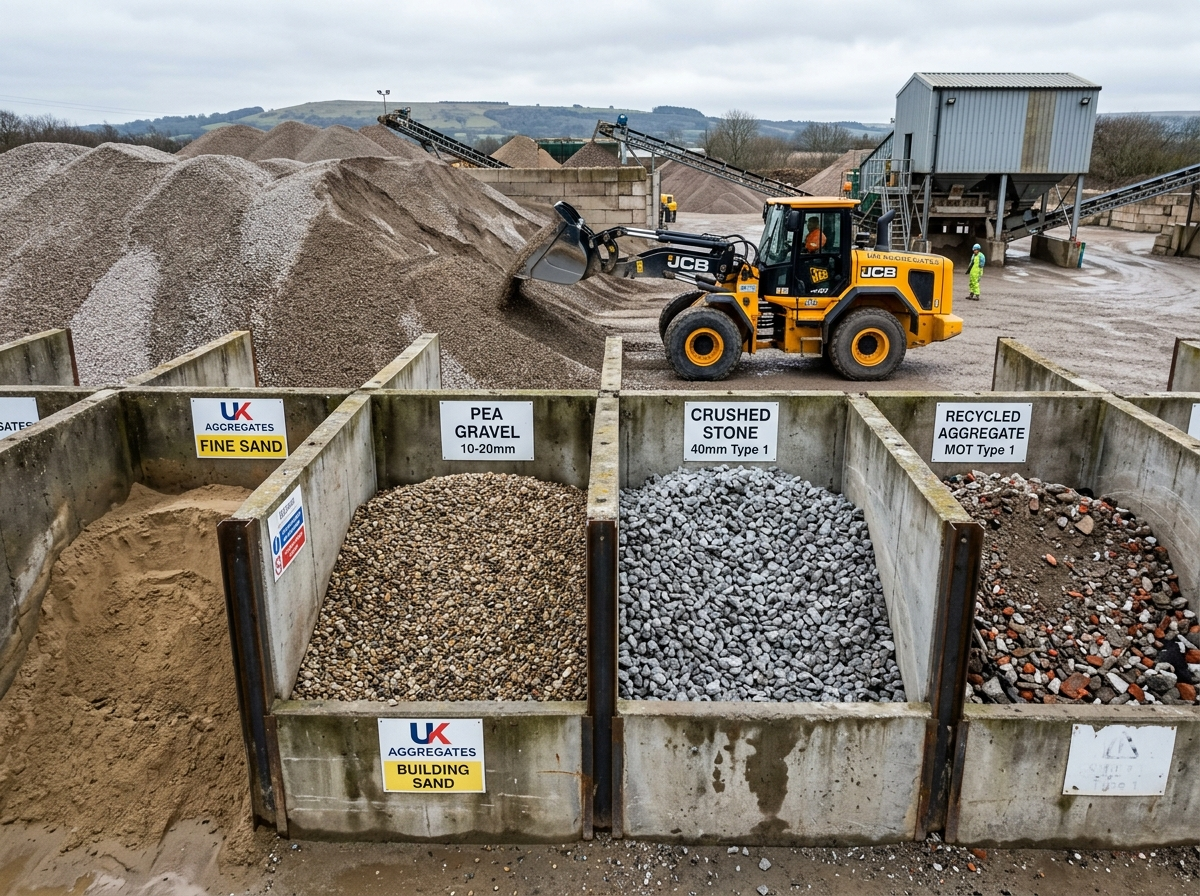
Why delivery scheduling matters for quarry operations
Running a quarry is a complex balancing act. You are managing extraction, processing, stockpile levels, environmental compliance, and — critically — getting the right material to the right customer at the right time. Of all these challenges, delivery scheduling is often the one that causes the most day-to-day friction.
Poor scheduling leads to a cascade of problems. Vehicles queue at the quarry face or the weighbridge, wasting driver hours and frustrating hauliers. Customers receive deliveries late — or not at all — damaging relationships and jeopardising contracts. The loading shovel sits idle while vehicles are stuck in traffic, then gets overwhelmed when they all arrive at once. And at month end, the invoicing team struggles to reconcile what was actually delivered against what was ordered.
Good scheduling, on the other hand, smooths out these peaks and troughs. It ensures a steady flow of vehicles through the site, keeps loading equipment utilised effectively, and gives customers the reliability they need. Here is how to get it right.
The challenges of aggregate delivery scheduling
Unpredictable demand
Construction projects drive aggregate demand, and construction is inherently unpredictable. A concrete pour gets brought forward, a road project is delayed, weather stops work on site — all of these changes ripple back to the quarry as last-minute order changes. A schedule that looked manageable at 7am can be completely disrupted by 9am.
Vehicle coordination
Many quarry operators rely on a mix of their own vehicles and third-party hauliers. Coordinating these different fleets — each with their own drivers, schedules, and priorities — adds complexity. A haulier running late on a previous job will arrive at your quarry off-schedule, potentially clashing with other vehicles and creating bottlenecks.
Loading constraints
Most quarries have a limited number of loading points and a finite amount of loading equipment. If six vehicles arrive simultaneously but you only have two loading shovels, four of them are going to wait. Staggering arrivals to match your loading capacity is essential but difficult to achieve without proper scheduling tools.
Weighbridge bottlenecks
Every vehicle must cross the weighbridge on entry and exit. If the weighbridge transaction is slow — particularly if it is still paper-based — it becomes a bottleneck that no amount of scheduling can fully resolve. Digital weighbridge software is a prerequisite for efficient delivery scheduling, not an optional extra.
Multi-product complexity
Quarries typically produce multiple products — various grades of aggregate, sand, fill material, and recycled products. Each product comes from a different stockpile and may require different loading equipment. Scheduling must account for not just when vehicles arrive, but what they need, where it is, and how it will be loaded.
Practical scheduling tips
1. Implement time-slot booking
The most effective way to manage vehicle flow is to implement a time-slot booking system. Instead of allowing hauliers to arrive whenever they choose, allocate specific arrival windows based on your loading capacity and weighbridge throughput.
A well-designed slot system:
- Matches arrivals to capacity — if you can load six vehicles per hour, offer six slots per hour
- Accounts for product type — different products may have different loading rates
- Allows flexibility — build in buffer slots for urgent orders and overruns
- Is easy for hauliers to use — ideally through a self-service portal or app
Time-slot booking transforms a chaotic free-for-all into a managed flow. It reduces waiting times, improves driver satisfaction, and makes your loading operation significantly more predictable.
2. Give hauliers real-time visibility
Hauliers do not want to arrive at your quarry and sit in a queue. If they can see the current status — how many vehicles are on site, whether their slot is running on time, whether there are any delays — they can adjust their own schedule accordingly.
A simple live status display, accessible via a web portal or app, reduces unnecessary phone calls to your office and helps hauliers plan their day more effectively. It also builds trust, because you are being transparent about what is happening on site.
3. Integrate scheduling with your weighbridge
When your scheduling system talks to your weighbridge software, the benefits multiply. A booked vehicle arrives, its registration matches a vehicle already on file, and the system knows what product it is collecting, which customer it is for, and what the agreed rate is. The weighbridge transaction becomes a confirmation rather than a data entry exercise.
This integration also enables you to track actual performance against the schedule. Which hauliers consistently arrive on time? Which slots are regularly over-subscribed? Where are the bottlenecks? This data is invaluable for refining your scheduling over time.
4. Plan around loading capacity, not just demand
It is tempting to schedule based purely on customer orders — if a customer needs 500 tonnes today, schedule enough vehicles to move 500 tonnes. But this ignores the constraint that actually determines throughput: your loading capacity.
Map your loading operation in detail. How many tonnes per hour can each loading point handle? How long does it take to switch between products? What happens when the loading shovel needs to refuel or the stockpile needs to be reorganised? Build your schedule around these real-world constraints, not around theoretical demand.
5. Buffer for the unexpected
No schedule survives contact with reality entirely intact. Vehicles break down, weather changes, orders get modified, and loading equipment needs maintenance. Build buffers into your schedule — both time buffers between slots and capacity buffers within each hour.
A schedule that is 100 per cent utilised on paper will fail in practice. Aim for 80 to 85 per cent utilisation, leaving room to absorb the inevitable disruptions without cascading delays through the rest of the day.
6. Communicate proactively
When disruptions do occur — and they will — communicate early. If a product is temporarily unavailable, if the weighbridge is down, or if loading is running behind schedule, let affected hauliers know as soon as possible. Proactive communication is far better received than silence followed by a long wait on arrival.
7. Review and refine regularly
Scheduling is not a set-and-forget exercise. Review your scheduling performance weekly. Look at average wait times, slot utilisation rates, and customer feedback. Identify patterns — is there a particular time of day when congestion is worst? Are certain customers consistently placing last-minute orders that disrupt the schedule? Use this data to continuously refine your approach.
Technology that supports better scheduling
Manual scheduling — using phone calls, whiteboards, and spreadsheets — can work for small, simple operations. But as volumes grow and complexity increases, it quickly becomes unmanageable.
Modern scheduling platforms designed for quarry and aggregate operations offer:
- Online slot booking for hauliers and customers
- Real-time site status showing vehicle count, queue length, and loading progress
- Integration with weighbridge and invoicing systems for end-to-end data flow
- Automated notifications via SMS or email when slots are confirmed, changed, or cancelled
- Reporting dashboards showing scheduling performance over time
- Route optimisation to suggest efficient delivery sequences
These tools do not replace the knowledge and judgement of an experienced quarry manager. They augment it, handling the routine coordination so that your team can focus on the exceptions and decisions that require human expertise.
The bottom line
Efficient delivery scheduling is not glamorous, but it is one of the most impactful improvements a quarry operator can make. It reduces costs, improves customer satisfaction, increases throughput, and makes the entire operation more predictable and manageable.
The quarries that schedule well — using time-slot booking, real-time visibility, and integrated platform tools — process more tonnes with less stress. Those that do not are stuck in a daily cycle of queues, phone calls, and apologies. The choice is straightforward.