
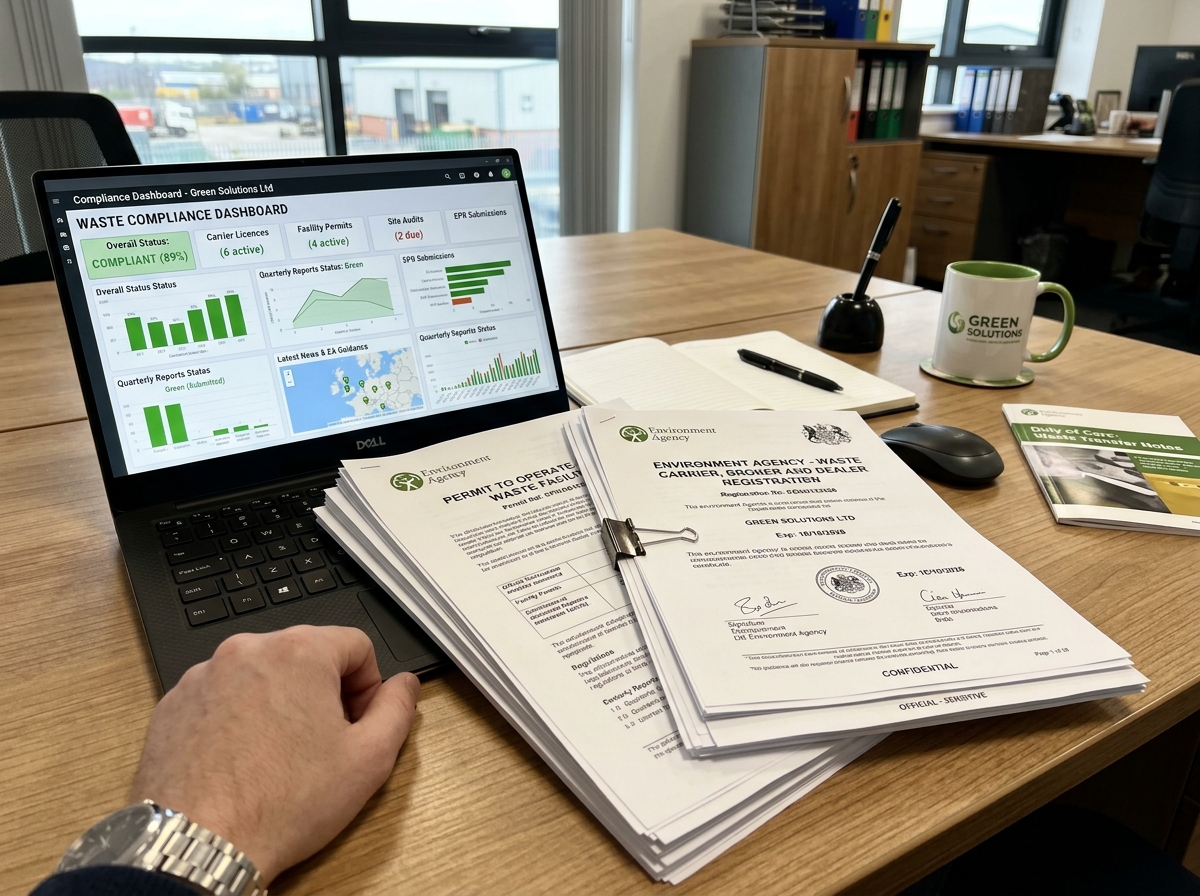
The compliance burden is growing
Waste carrier compliance in the UK is not getting simpler. The regulatory framework — spanning the Environmental Protection Act, the Waste (England and Wales) Regulations, the Hazardous Waste Regulations, and various duty of care requirements — places significant obligations on anyone who collects, transports, or disposes of waste.
The consequences of non-compliance are serious. The Environment Agency can issue enforcement notices, impose civil sanctions, or pursue criminal prosecution. Fines can reach unlimited amounts for serious offences. And beyond the legal penalties, a compliance failure can destroy customer confidence and exclude you from lucrative contracts that require demonstrated regulatory adherence.
For waste carriers, the challenge is not a lack of willingness to comply — it is the sheer volume of documentation, record-keeping, and reporting required. Managing this manually, across dozens of vehicles and thousands of transactions, is increasingly impractical.
What compliance actually requires
Waste carrier registration
Every business that transports waste in the UK must be registered as a waste carrier with the relevant environmental regulator. There are two tiers:
- Lower tier — For businesses that only carry their own waste, or certain types of waste that are not their main business activity. Registration is free and does not expire.
- Upper tier — For businesses whose main activity involves transporting waste, or that transport other people’s waste. Registration costs a fee, must be renewed every three years, and can be refused or revoked.
Your software should track registration status and expiry dates for your business and, critically, for any subcontractors or third-party carriers you use. If a subcontractor’s registration lapses and they continue carrying waste on your behalf, you share the regulatory exposure.
Duty of care
The duty of care applies to everyone in the waste chain — from the producer to the final disposer. For waste carriers, the key obligations are:
- Preventing the escape of waste during transport
- Ensuring waste is transferred only to authorised persons
- Providing an accurate description of the waste
- Completing and retaining waste transfer documentation
This last point — documentation — is where the administrative burden falls heaviest. Every transfer of waste requires a waste transfer note (or, for hazardous waste, a consignment note) that records who transferred it, who received it, what it was, how much there was, and where it is going.
Waste transfer notes
A waste transfer note (WTN) must contain:
- A description of the waste, including the EWC (European Waste Catalogue) code
- The quantity of waste (by weight or volume)
- The type of container
- The date and time of transfer
- The names, addresses, and waste carrier registration numbers of both parties
- The place of transfer
- The SIC code of the waste producer
WTNs must be retained for at least two years (three years for hazardous waste consignment notes). They must be produced on demand for inspection by the Environment Agency.
For a busy waste carrier processing hundreds of collections per week, generating, distributing, and storing these documents manually is a significant administrative undertaking.
Hazardous waste requirements
If you transport hazardous waste, the compliance requirements step up considerably. Consignment notes are more detailed than standard WTNs, requiring additional information about the physical and chemical properties of the waste, its hazard codes, and the specific disposal or recovery operation planned.
Hazardous waste movements must also be recorded on the hazardous waste consignment note system, and there are additional requirements around segregation during transport, driver training, and vehicle marking (ADR regulations for certain waste types).
Record-keeping and reporting
Beyond individual transaction documents, waste carriers must maintain broader records including:
- A register of waste carried, with details of each load
- Records of rejected loads and the reasons for rejection
- Evidence of employee training on waste handling and compliance
- Vehicle inspection and maintenance records relevant to safe waste transport
Some waste carriers are also required to submit annual returns or provide data for the regulator’s waste data interrogator system.
How software transforms compliance
Automated document generation
The most immediate benefit of compliance-capable software is the automatic generation of waste transfer notes and consignment notes. When a collection job is completed, the system generates the appropriate document using data already captured during the order and job management process:
- Customer details from the CRM
- Waste descriptions and EWC codes from the job specification
- Quantities from the weighbridge or driver-recorded weights
- Carrier and site details from the system configuration
The operator does not fill in a form. The document is generated, distributed to the relevant parties, and stored — all automatically.
Digital storage and retrieval
Paper waste transfer notes stored in filing cabinets are a compliance risk. They get misfiled, damaged, or lost entirely. When the Environment Agency requests documentation for a specific load from six months ago, finding it quickly is far from guaranteed.
Digital storage solves this problem comprehensively. Every document is stored against the relevant job, customer, and vehicle. Searching, filtering, and retrieving records takes seconds rather than hours. And because the data is structured (not just scanned images), you can run queries across your entire history — for example, “show me all hazardous waste movements for this customer in the last 12 months.”
Expiry and renewal tracking
Compliance is not a one-time event. Carrier registrations expire. Permits have conditions. Driver certifications need renewal. Environmental permits are reviewed. A compliance-aware system tracks all of these dates and generates alerts before deadlines are missed.
This proactive approach is particularly important for managing subcontractors and third-party carriers. If you use 15 different hauliers, keeping track of their individual registration statuses manually is a full-time job. Software does it automatically.
Audit trail and accountability
Regulators want to see not just that the right documents exist, but that the right processes were followed. A digital system provides a complete audit trail: who created the record, when, what data was entered, and whether it was subsequently modified.
This level of accountability is almost impossible to achieve with paper-based systems. It is built in to a digital system by default.
Exception management
Not every load goes smoothly. Waste may be rejected at the disposal site because it does not match the description. A driver may identify a contamination issue at the point of collection. A customer may present waste that requires a different classification than expected.
Good compliance software handles these exceptions within the normal workflow — capturing the details, generating the appropriate documentation, notifying the relevant people, and maintaining the record. Exceptions that are managed within the system are far less likely to become compliance incidents than those handled on the fly with paper and phone calls.
Building a compliance culture
Software is a tool, not a solution. It automates the mechanics of compliance, but it does not replace the need for a culture that takes compliance seriously. That culture starts with leadership and is sustained through:
- Training — Every employee who handles waste needs to understand the regulations that apply to their role, not just the buttons to press in the software
- Clear processes — Documented procedures for standard operations and, critically, for exceptions and escalations
- Regular auditing — Internal audits that check not just whether documents exist, but whether processes are being followed consistently
- Accountability — Clear ownership of compliance responsibilities at every level of the organisation
The cost of getting it wrong
A compliance failure is not just a regulatory problem — it is a business problem. Consider the consequences:
- Financial penalties — Fines for waste duty of care offences can be substantial
- Operational disruption — Enforcement notices can restrict or suspend operations
- Reputational damage — Compliance failures become public record and are visible to customers and competitors
- Contract losses — Many commercial and public-sector contracts require demonstrated compliance records; a failure can exclude you from future tenders
- Personal liability — Directors and senior managers can be held personally liable for waste offences
Against these risks, the cost of implementing proper compliance tracking software is modest. It is not a cost — it is insurance.
Getting started
If your current compliance processes rely heavily on manual document creation, paper storage, and spreadsheet tracking, the transition to digital compliance management does not have to be overwhelming.
Start with the highest-volume, highest-risk area — typically waste transfer note generation and storage. Once that process is digital and automated, extend to hazardous waste management, expiry tracking, and reporting.
The goal is a system where compliance happens as a byproduct of normal operations, rather than as a separate, burdensome administrative process. When your drivers complete a job, the compliance documentation is generated. When a load crosses the weighbridge, the regulatory record is created. When a permit nears expiry, someone is notified.
That is the promise of digital compliance — not just surviving regulation, but handling it efficiently and confidently.