
The spreadsheet problem
Spreadsheets are the default management tool for thousands of UK waste, aggregate, and plant businesses. They are flexible, familiar, and free (or close to it). For a small operation, they work well enough.
But “well enough” has a ceiling. And for most growing businesses, that ceiling arrives sooner than expected.
The pattern is always the same. The business starts with a simple spreadsheet for tracking weighbridge tickets. Then another for fleet maintenance. Another for customer pricing. Another for driver schedules. Another for monthly invoicing. Before long, the operation is running on a patchwork of interconnected spreadsheets that nobody fully understands, one person knows how to maintain, and everyone is afraid to change.
This is not a technology problem — it is an operational risk.
Where spreadsheets fail heavy industry
Data lives in silos
In a spreadsheet-based operation, weighbridge data is in one file, fleet records in another, and invoicing in a third. When a vehicle arrives at your weighbridge, the operator writes a ticket. That ticket is later entered into a weighbridge spreadsheet. At the end of the week (or month), someone copies the relevant data into an invoicing spreadsheet, looks up the customer pricing, and generates invoices manually.
Every handoff is an opportunity for error. Every copy-paste is a risk. And when something does not match — a disputed weight, a missing ticket, an incorrect price — tracking down the discrepancy means checking multiple files, comparing dates, and hoping someone did not accidentally delete a row.
No real-time visibility
Spreadsheets are snapshots. They tell you what was true when someone last updated them. They cannot tell you what is happening right now.
How many vehicles are on site? What is today’s tonnage? Which drivers have not reported in? Is a particular vehicle overdue for maintenance? None of these questions can be answered by a spreadsheet without someone manually updating it — and by the time they do, the answer may have changed.
For operations managers, this lack of real-time visibility means making decisions based on incomplete or outdated information. For business owners, it means not knowing the true state of the operation until someone compiles a report.
Compliance is manual and fragile
Environmental compliance in the waste industry is not optional. You need accurate records of every waste movement, material classification, tonnage by permit, and hazardous waste handling. Spreadsheets can store this data, but they cannot enforce it.
Nothing prevents an operator from entering an incorrect material code, skipping a required field, or transposing a number. When the Environment Agency requests a waste data return, producing it from spreadsheets typically takes days of manual compilation — and the accuracy depends entirely on the quality of the original data entry.
They do not scale
A spreadsheet that works for 20 vehicles per day becomes unmanageable at 200. A pricing structure that works for 10 customers becomes error-prone at 100. A single-site operation can tolerate spreadsheets; a multi-site business cannot.
The typical response is to add more spreadsheets, more tabs, more formulas, and more people to manage them. But this compounds the problem rather than solving it. More spreadsheets mean more handoffs, more version conflicts, and more places for errors to hide.
What an integrated platform changes
Moving from spreadsheets to an integrated platform like Heavy Tech is not about replacing one tool with another. It is about eliminating the gaps between your operational processes.
Weighbridge to invoice in one flow
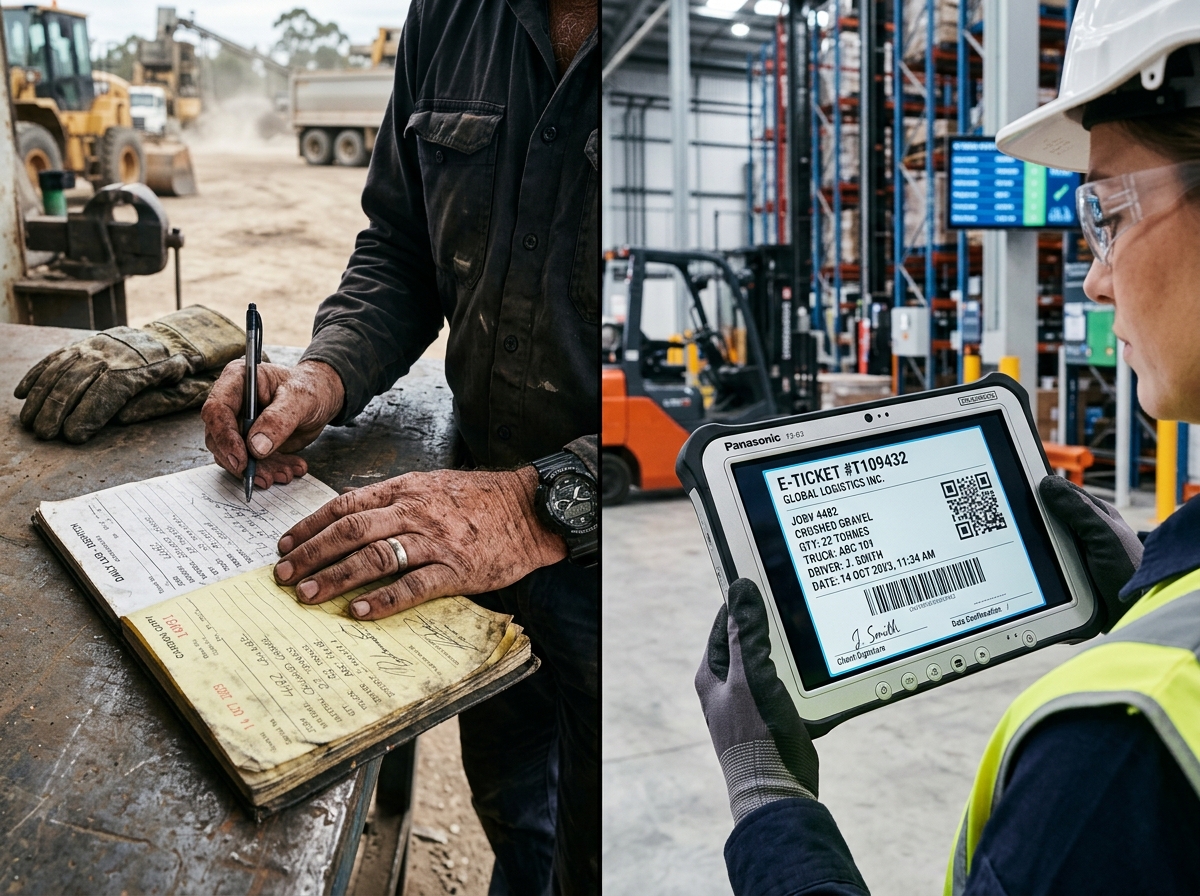
When a vehicle arrives at a Heavy Tech weighbridge, the ticket is raised against the vehicle already on file. Entry and exit weights are recorded, the net is worked out, the material is classified, and an e-ticket exists.
That e-ticket flows directly into invoicing. The rate was resolved when the ticket was raised, so the invoice run groups closed tickets by customer and produces the PDF — no re-keying, no lookups, no pricing arguments.
The same data that was entered once at the weighbridge is used for invoicing, compliance reporting, and fleet tracking. No copies, no handoffs, no silos.
Fleet data that stays current
Fleet and haulier records are not a separate system to maintain. A vehicle is held once, against your own fleet or against the haulier who runs it, and every weighbridge ticket and route stop refers back to that record.
Instead of a spreadsheet that someone updates when they remember, you have a system that updates itself and warns you when action is needed.
Routes that optimise themselves
Planning delivery or collection routes on a spreadsheet means someone spending an hour (or more) each morning figuring out the best order for the day’s stops. Route optimisation does this in seconds, using algorithms that account for distance, capacity, time windows, and vehicle restrictions.
The result is typically 15-25% fewer miles driven, which translates directly into fuel savings and more jobs completed per day.
Compliance that is built in
When every waste movement is recorded digitally with mandatory material classification, operator ID, and timestamps, compliance reporting becomes a byproduct of normal operations — not a separate administrative task.
Permit tonnage tracking, waste data returns, and audit trails are generated automatically from the same data your team enters during their normal workflow.
The real cost of spreadsheets
The cost of spreadsheets is not the software — it is the labour.
Consider the time your team spends on:
- Manual data entry: Re-keying weighbridge tickets, copying data between files, looking up pricing
- Error correction: Finding and fixing data entry mistakes, resolving invoice disputes, reconciling mismatched records
- Report generation: Compiling weekly, monthly, and regulatory reports from multiple spreadsheet sources
- Communication: Phone calls and emails to check vehicle status, driver availability, job completion
- Context switching: Moving between different spreadsheets, systems, and processes throughout the day
For most operations, this adds up to several hours per day across the team. At scale, it can be multiple full-time equivalents spent on administrative overhead that an integrated system eliminates.
Making the transition
The most common objection to switching from spreadsheets is disruption. “We know how our spreadsheets work. Changing will slow us down.”
This is true for about a week. Modern platforms are designed for fast implementation — most operations are up and running within days, not months. The learning curve is minimal because the software mirrors the operational workflows your team already follows.
The bigger risk is not switching. Every month on spreadsheets is another month of manual data entry, avoidable errors, and missed insights. The question is not whether integrated software is better than spreadsheets — everyone knows it is. The question is how much longer you can afford the overhead.
What to look for in a platform
If you are ready to move beyond spreadsheets, here is what matters:
- Integration: Every module should share data automatically. Weighbridge, fleet, routing, and invoicing should be one system, not four modules bolted together.
- Implementation speed: You should be operational within weeks. Lengthy implementations are a sign of legacy architecture.
- Industry-specific design: Generic business software will leave you building workarounds. Choose a platform built for your industry.
- UK focus: Compliance requirements, tax handling, and operational norms differ by country. A UK-focused platform will handle these natively.
Heavy Tech replaces spreadsheets with a single integrated platform for waste management, aggregates, and construction. Book a demo to see how it works for your operation.