
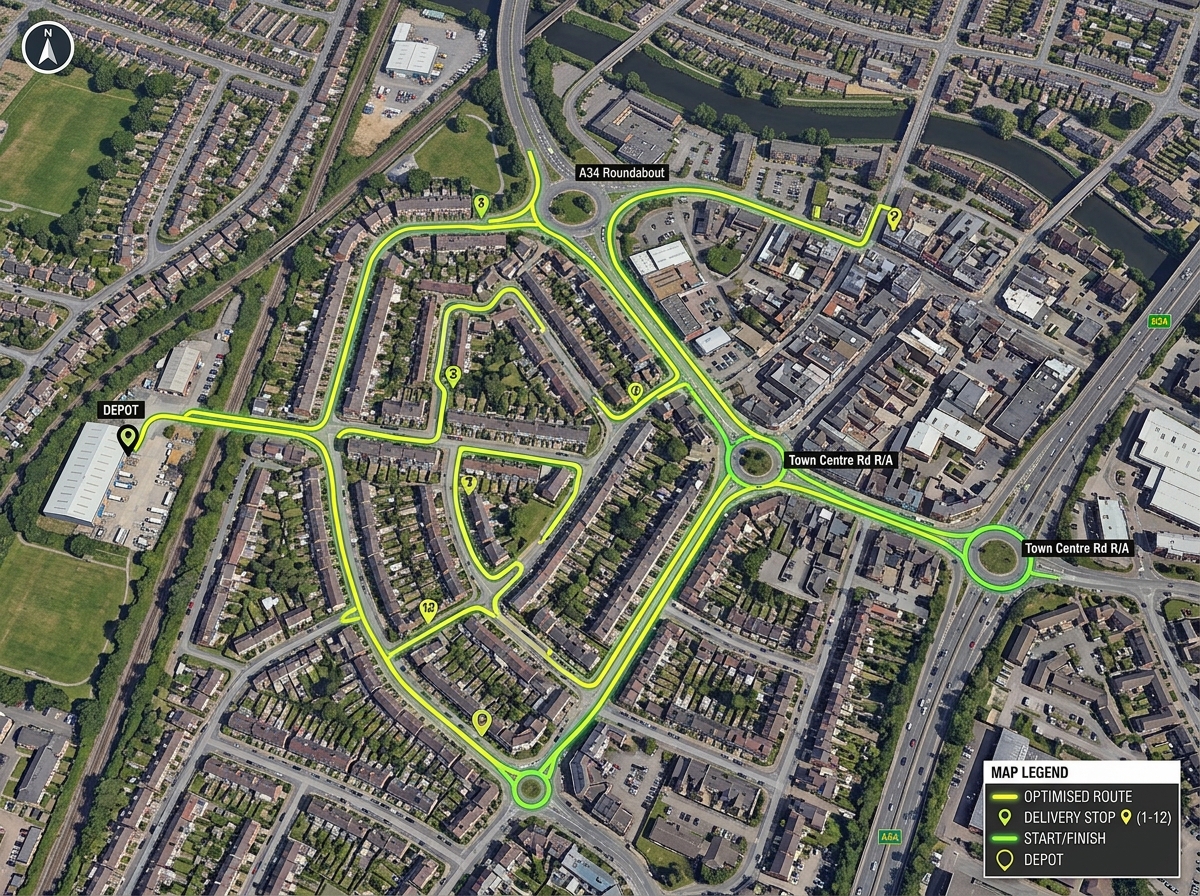
The hidden cost of unoptimised routes
Most waste collection businesses plan their routes the same way they have for years: an experienced planner sits down with a list of jobs and builds routes based on local knowledge, habit, and instinct. This approach can work — up to a point. But it almost certainly leaves money on the table.
Studies consistently show that manual route planning produces routes that are 15-25% longer than optimised alternatives. For a fleet of 20 vehicles, each covering 150 miles per day, that inefficiency translates to hundreds of thousands of pounds in unnecessary fuel, labour, and vehicle wear over the course of a year.
Route optimisation software uses algorithms to calculate the most efficient sequence of stops, factoring in variables that no human planner can hold in their head simultaneously: traffic patterns, vehicle capacities, time windows, road restrictions, driver hours, and the locations of disposal sites.
How route optimisation works in practice
Gathering the inputs
Effective optimisation starts with good data. The system needs to know:
- Job locations — The addresses of every collection point, ideally geocoded to precise coordinates rather than postcodes
- Time windows — When each customer expects their collection (for example, before 10am for a commercial customer)
- Vehicle constraints — The capacity, type, and legal restrictions for each vehicle in the fleet (weight limits, height restrictions, ADR requirements for hazardous loads)
- Disposal and tipping points — Where vehicles need to go to empty, and the operating hours of those facilities
- Driver information — Start and end locations, working time directive limits, and any route-specific knowledge or restrictions
Building optimised routes
With these inputs, the optimisation engine calculates routes that minimise total distance (or time, or cost — depending on your priority) while respecting every constraint. The algorithm considers thousands of possible permutations that would take a human planner hours or days to evaluate.
The output is a set of routes, one per vehicle, with jobs sequenced in the optimal order. Most systems present these visually on a map, making it easy for planners to review and adjust before dispatching.
Dynamic re-optimisation
The real world does not follow the plan. A vehicle breaks down. A customer calls to add an urgent collection. A road is closed. Good route optimisation systems handle these disruptions with dynamic re-optimisation — recalculating routes in real time to accommodate changes without requiring the planner to start from scratch.
This capability is what separates modern optimisation tools from simple mapping software. It is not enough to plan a good route in the morning; you need a system that keeps routes optimal throughout the day.
The measurable benefits
Fuel savings
Fuel is typically the largest variable cost for a waste collection fleet. Reducing total mileage by even 10% through better routing has a direct and immediate impact on the fuel bill. For a mid-size fleet, this often represents savings of several thousand pounds per month.
Beyond mileage, optimised routes also reduce idle time and the stop-start driving that increases fuel consumption. Routes that flow logically — minimising backtracking and unnecessary turns — are inherently more fuel-efficient.
More jobs per vehicle per day
When routes are shorter and more logical, drivers can complete more collections in the same working hours. This has a compounding effect: you can serve more customers without adding vehicles, or you can handle growth without proportionally increasing your fleet size.
Some businesses find that optimisation allows them to retire one or two vehicles entirely, eliminating not just fuel costs but also insurance, maintenance, and depreciation for those assets.
Reduced driver overtime
Poorly planned routes frequently push drivers past their scheduled hours, triggering overtime payments and creating working time directive compliance risks. Optimised routes are designed to fit within available hours, reducing both the cost and the regulatory exposure of overtime.
Better customer service
Customers care about reliability. When your routes are optimised and tracked, you can provide accurate collection windows, send real-time notifications, and respond quickly when something goes wrong. This level of service used to be the preserve of large national operators — optimisation software makes it achievable for businesses of any size.
Lower emissions
Route optimisation is one of the most practical steps a waste business can take to reduce its carbon footprint. Fewer miles driven means less diesel burned, which means fewer emissions. For businesses pursuing environmental accreditations or responding to customer sustainability requirements, optimised routing provides measurable, reportable reductions.
What to consider when choosing route optimisation software
Waste-specific functionality
Generic logistics optimisation tools do not understand the waste industry. They do not know about tipping runs, bin presentations, or the difference between a front-end loader and a rear-end loader. Choose software that has been built for — or at least thoroughly adapted to — waste collection operations.
Key waste-specific features include:
- Support for multi-compartment vehicles
- Tipping point management and scheduling
- Bin and container tracking
- Integration with weighbridge systems for disposal recording
- Duty of care and waste transfer note generation
Integration with existing systems
Route optimisation delivers its full value when it is connected to the rest of your operation. Routes should reach the driver on a phone, and a completed stop should carry a signature and a photograph back with it. Those completed stops should then feed invoicing directly, rather than being read off a paper docket days later.
A standalone optimisation tool that requires manual data transfer to and from other systems will never achieve the efficiency gains that an integrated platform provides.
Ease of use for planners
The most sophisticated algorithm in the world is useless if your route planners cannot use it effectively. Look for software with a clean, intuitive interface that lets planners see routes on a map, drag and drop jobs between vehicles, and override the algorithm when their local knowledge is genuinely better.
The goal is to augment your planners’ expertise, not replace it. The best implementations treat optimisation as a powerful suggestion engine that planners can trust but also adjust.
Scalability and performance
Optimisation is computationally intensive. A system that works well for 10 vehicles and 200 jobs may struggle with 50 vehicles and 2,000 jobs. Test with realistic data volumes and check that the system can produce results in a reasonable time frame — ideally seconds, not minutes.
Getting started with route optimisation
If you are new to route optimisation, start with a baseline. Track your current routes for a few weeks — total mileage, jobs completed, fuel consumed, and overtime hours. This gives you a clear benchmark against which to measure the impact of optimisation.
Most businesses see a measurable improvement within the first month of using optimised routes. The efficiency gains tend to grow over time as the system accumulates more data about your operation and as your planners become more skilled at working with the tool.
The waste collection industry is under relentless pressure to do more with less: more collections, fewer vehicles, lower emissions, tighter margins. Route optimisation is not a luxury — it is a fundamental tool for any business that wants to remain competitive. The technology is proven, the savings are real, and the businesses that have already adopted it are pulling ahead.