
The state of software in UK waste management
The UK waste management industry processes over 200 million tonnes of material annually, employs hundreds of thousands of people, and operates under one of the most demanding regulatory frameworks in the world. Yet a remarkable number of waste businesses still run critical operations on spreadsheets, paper forms, and disconnected legacy systems.
This is changing. Driven by tightening regulations, rising costs, labour shortages, and customer expectations, waste businesses across the UK are investing in modern software platforms. But the market is fragmented, the terminology is inconsistent, and choosing the right system is far from straightforward.
This guide aims to cut through the noise, explaining what waste management software actually does, what UK-specific requirements you need to consider, and how to evaluate the options available.
What waste management software covers
The term “waste management software” is broad enough to be almost meaningless. In practice, it can refer to any combination of the following capabilities:
Operational management
The day-to-day running of a waste business involves scheduling collections, dispatching vehicles, managing customer orders, and tracking job completion. Operational management modules handle this workflow, providing:
- Job creation and scheduling
- Vehicle and driver dispatch
- Real-time progress tracking
- Route planning and optimisation
- Customer communication (notifications, ETAs)
Weighbridge and site management
For businesses that operate transfer stations, recycling facilities, or landfill sites, weighbridge management is a critical function. This includes:
- Automated weighing with ANPR vehicle recognition
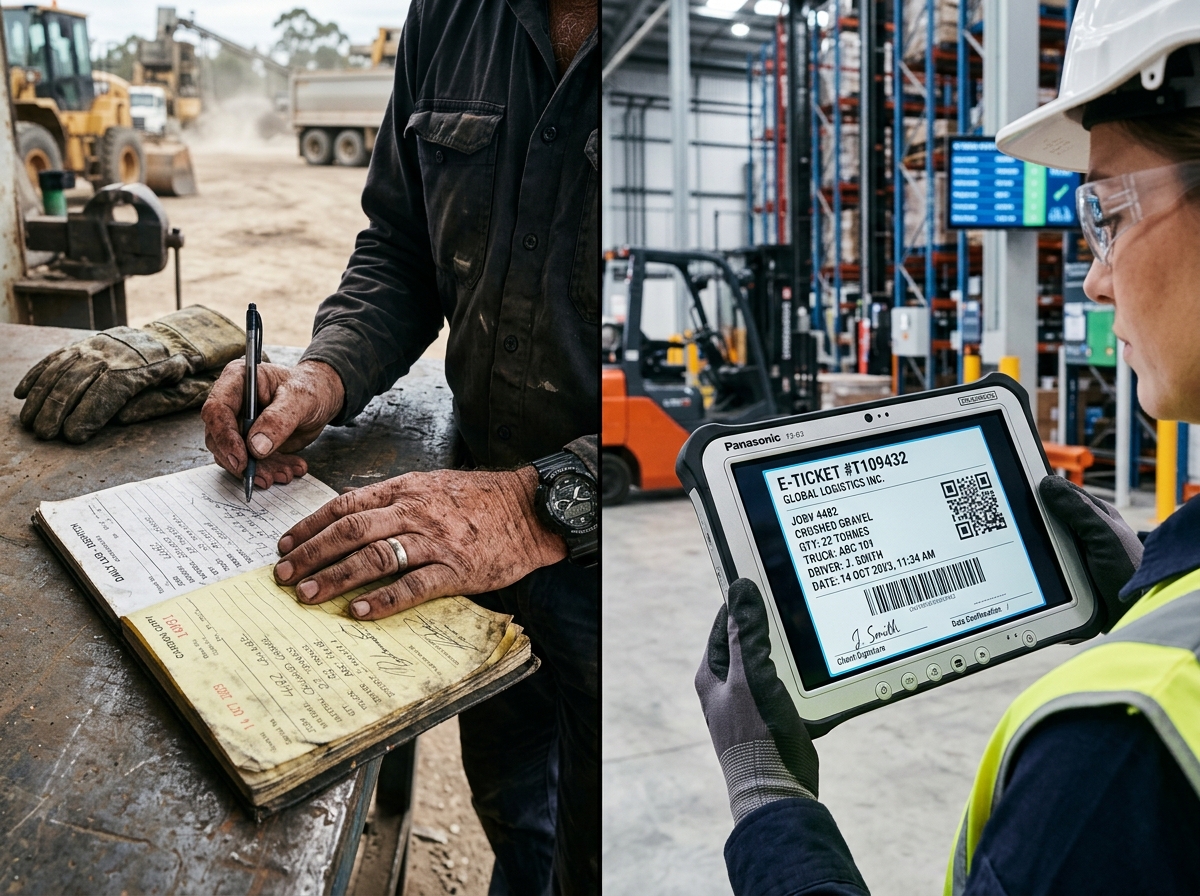
- E-ticket generation and distribution
- Material classification and coding
- Pricing and charge calculation
- Site access control
Waste compliance and regulatory reporting
UK waste regulations require meticulous record-keeping. Software that supports compliance typically handles:
- Waste transfer notes (WTNs) — Digital generation and storage of the documents required for every waste movement
- Hazardous waste consignment notes — For controlled waste, with the additional data fields and approval workflows required
- EWC coding — Correct classification of waste using European Waste Catalogue codes
- Duty of care auditing — Demonstrating that waste has been handled, transported, and disposed of by appropriately licensed operators
- Environment Agency reporting — Data exports formatted for regulatory submissions
Fleet and vehicle management
Waste collection vehicles are expensive assets that require careful management. Fleet modules typically cover:
- Vehicle maintenance scheduling and history
- MOT, tax, and insurance tracking
- Fuel consumption monitoring
- Defect reporting (daily walkaround checks)
- Working time directive compliance for drivers
Commercial and financial management
The commercial side of a waste business has its own complexity: variable pricing, hire periods, surcharges, rebates, and credit control. Financial modules handle:
- Quotation and contract management
- Automated invoicing based on operational data
- Integration with accounting software (Xero, Sage, QuickBooks)
- Credit control and statement generation
- Profitability analysis by customer, route, or material
UK-specific considerations
Regulatory landscape
The UK waste regulatory framework is administered by the Environment Agency (in England), Natural Resources Wales, SEPA (in Scotland), and NIEA (in Northern Ireland). While the broad principles are similar, there are jurisdictional differences in reporting requirements, licence conditions, and enforcement approaches.
Your software needs to support the specific regulatory requirements of the jurisdictions you operate in. This is one reason why UK waste businesses often find that software built for the North American or European market does not quite fit — the compliance requirements are different in ways that matter.
Duty of care
The duty of care framework places a legal obligation on every business that produces, carries, keeps, or disposes of waste to ensure it is managed properly. This means maintaining complete records of every waste movement, including who handled it, where it went, and how it was classified.
Software that automates duty of care compliance — generating the right documents, capturing the right data, and maintaining the right audit trails — is not just convenient; it is a practical necessity for any business handling significant waste volumes.
Making Tax Digital
HMRC’s Making Tax Digital initiative requires businesses to maintain digital records and submit VAT returns using compatible software. Your waste management system needs to either integrate with MTD-compatible accounting software or be MTD-compatible itself.
Data protection
The UK GDPR applies to any customer, driver, or employee data held within your waste management system. Ensure your chosen platform has appropriate data protection measures, including access controls, data encryption, and the ability to respond to subject access requests.
Evaluating your options
Integrated platform vs best-of-breed
The fundamental architectural decision is whether to choose a single integrated platform that covers all your needs, or to assemble a collection of best-of-breed tools — one for routing, another for weighbridge, a third for invoicing, and so on.
The best-of-breed approach can give you the strongest individual tools, but it creates integration challenges. Data needs to flow between systems, and that flow is never as seamless as vendors promise. You end up spending time and money maintaining integrations, reconciling data, and troubleshooting when things go wrong.
An integrated platform trades some individual feature depth for the enormous benefit of having all your data in one place. When a weighbridge transaction flows directly into an invoice without any manual intervention, the operational efficiency gains are substantial.
For most UK waste businesses, particularly those in the small-to-medium range, an integrated platform is the better choice. The integration headaches of a multi-vendor approach are simply not worth the marginal feature advantages.
Cloud vs on-premise
The debate between cloud-hosted and on-premise software is largely settled in favour of cloud. Modern cloud platforms offer:
- Automatic updates and maintenance
- Access from any device with an internet connection
- Built-in redundancy and disaster recovery
- Lower upfront costs (subscription vs capital expenditure)
- Better scalability as your business grows
The only legitimate concern with cloud software for waste businesses is connectivity at remote sites. However, most modern platforms handle this with offline-capable mobile apps that sync when connectivity is available.
Implementation and support
The best software in the world is useless if it is poorly implemented. When evaluating vendors, pay close attention to:
- Implementation methodology — Does the vendor have a structured onboarding process, or is it “here’s your login, good luck”?
- Data migration — How will your existing data (customers, vehicles, pricing, historical records) be brought into the new system?
- Training — Is training included, and is it tailored to different user roles (office staff, drivers, managers)?
- Ongoing support — What support channels are available, and what are the response times? UK-based support is a significant advantage when you need help at 7am on a Monday morning.
Common mistakes when choosing waste management software
Buying on features alone
A long feature list is not the same as a good system. The features that matter are the ones you will actually use, configured in a way that matches your workflow. A system with 200 features, 180 of which are irrelevant to your operation, is harder to learn and maintain than a focused system that does exactly what you need.
Underestimating change management
Technology adoption is a people problem, not a technology problem. Your team needs to understand why the change is happening, how it will affect their daily work, and what support is available during the transition. Budget time and energy for training, communication, and the inevitable teething problems.
Ignoring the total cost of ownership
The monthly subscription fee is not the total cost. Factor in implementation fees, training costs, hardware requirements (tablets for drivers, ANPR cameras, kiosk screens), integration costs, and the internal time your team will spend on the project.
Choosing a system that cannot grow with you
Your business will change. You may add new services, open new sites, or acquire competitors. Choose a platform that can accommodate growth without requiring a complete system replacement. Ask vendors how their existing customers have scaled, and what that process looked like.
Taking the next step
The UK waste management industry is at an inflection point. The businesses that invest in modern software now will be better positioned to handle regulatory change, compete for contracts, attract and retain staff, and operate profitably in an increasingly demanding market.
Start by honestly assessing where your current systems are falling short. Talk to your operations team, your drivers, your finance team, and your customers. The pain points they describe will guide you towards the features and capabilities that matter most for your business.
Then talk to vendors — but talk to their customers too. The real measure of any software platform is not what it promises on a demo, but what it delivers in daily use at a business like yours.